
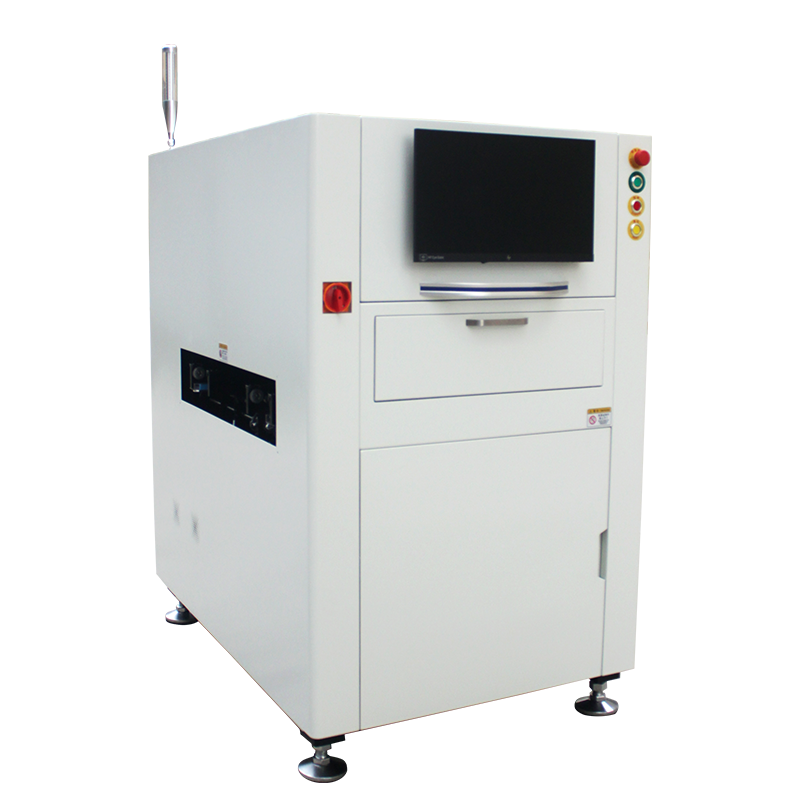
Last year, we delivered a batch of ECU control boards to an automotive Tier 1 supplier. Only 5,000 pieces—nothing huge. But we got back 127 defective boards. All of them had the same issue: cold solder joints on bottom-side capacitors.
Here's the kicker—we already had an AOI on our line. A "high-precision" imported brand, no less. But it was a single-sided machine. It couldn't see the bottom of the board at all. The customer caught the problem with their X-ray sampling, but by then we'd already shipped three lots.
That incident pushed me over the edge. I knew we had to get a double-sided system. But honestly, even after we signed the PO, I had serious doubts—Can Double-Sided Automatic AOI Inspection Equipment actually deliver what the spec sheet promises? After running it for nearly a year, I have some real-world answers. No fluff. Just what I've learned on the shop floor.
Why Single-Sided AOI No Longer Cuts It
Let me give you some context about our operation. We do consumer electronics and automotive modules—board sizes ranging from smartphone PCBs to power management boards up to 20×15cm. The customer requirements have gotten brutal over the past two years. Double-sided placement is basically mandatory now. BGAs, QFNs, LGAs—these bottom-termination packages are everywhere.
With our old single-sided AOI, we had an unspoken "rule" in the factory: any component on the bottom side gets inspected by human eyes after reflow. Three operators sitting at the end of the line, magnifying glasses in hand, checking every board. Efficiency was terrible, and our miss rate stayed between 8% and 12% month after month. Here's the real killer—human eyes can't measure solder joint height or coplanarity. If a QFN on the bottom side had poor fillet wetting, our operators simply couldn't see it.
We did a forensic analysis of every customer return over two years. Bottom-side component defects accounted for 43% of all field failures. Of those, over 70% were in areas that our single-sided AOI couldn't even look at. I put that data in front of our plant manager, and he finally approved the budget.
We didn't scrap the old single-sided AOI—we moved it to the printer output for supplementary SPI-style checking. But the main post-reflow inspection station had to be upgraded to Double-Sided Automatic AOI Inspection Equipment. That was the first decision we made.
The Selection Process: I Wasn't Sold by a PowerPoint
Once we decided to go double-sided, I talked to five suppliers—three domestic brands and two import names. Honestly, I walked in biased toward the imports. Our old single-sided AOI was an import, and while it was expensive, it was at least reliable. But after running side-by-side trials, my opinion on domestic equipment changed completely.
Here's one comparison that stuck with me. We prepared a test panel with known defects—bottom-side capacitor misalignment, BGA head-in-pillow, QFN insufficient side-wetting. We ran each supplier's machine against the same panel.
Two of the import brands struggled badly with bottom-side QFN height measurement. They flagged good boards as failures and let actual bad boards slip through. Their field engineers later explained that their bottom-side lighting module didn't handle dark solder mask (we use matte black on many boards) very well—too much signal absorption, too much reflection noise.
The demo unit from Shenzhen HanChengTong Technology Co., Ltd handled the bottom-side inspection much more consistently. Their technician pointed out that this Double-Sided Automatic AOI Inspection Equipment includes an additional ring-shaped low-angle light array specifically designed for dark substrates and reflective components. We ran our test panels through three times. The miss rate was 0.3% and the false call rate was 4.2%—and those numbers held up after we installed the machine and ran real production boards for a month.
Price was obviously a factor too. The imports quoted us $50,000–$65,000 on average. The domestic equivalents were in the $25,000–$35,000 range. Shenzhen HanChengTong Technology Co., Ltd came in at $31,000 including installation and commissioning. That price-performance ratio made the decision a lot easier.
Month One: Pain and Surprise in Equal Measure
The machine arrived, and we scheduled two weeks for installation, commissioning, and operator training. I'll be honest—the first ten days were rough.
Programming was the biggest headache. The supplier promised "auto-programming," but our line runs high-mix, low-volume—meaning we switch board types constantly. For every new board, we had to spend hours fine-tuning the inspection windows. The system's auto-generated detection frames kept grouping adjacent solder joints together on the bottom side, especially where components were densely packed. During the first week, one of our engineers spent three hours a day just manually adjusting thresholds and regions of interest. That wasn't in the sales pitch.
Then came the integration headache. We have a four-year-old smt glue dispenser on the same line—an old screw-pump model with inconsistent dot diameter. Once the Double-Sided Automatic AOI Inspection Equipment went live, it started flagging bottom-side glue dot offsets and insufficient glue volume left and right. The defects had always been there—we just never had a way to detect them before. We ended up spending another week recalibrating that old smt glue dispenser, replacing the needle, and installing a new precision pressure regulator. That finally brought the glue consistency back to spec.
But surprises came too—good ones. In the second week, the Double-Sided Automatic AOI Inspection Equipment flagged the same inductor on a power supply board for solder ball spatter on three consecutive production lots. Our process engineer traced the issue back to the reflow oven—Zone 3 was running 12°C above its setpoint. The temperature drift had crept in gradually over several weeks. Our weekly oven profiling hadn't caught it. If the double-sided AOI hadn't flagged that pattern, we would have shipped thousands of boards with intermittent solder ball risks.
The Closed-Loop Feedback: Where AOI Actually Earns Its Keep
A lot of my peers treat AOI as a "final exam"—boards come out of the oven, get photographed, and that's the end of it. But my experience has been completely different. The real value of Double-Sided Automatic AOI Inspection Equipment is the data it feeds back to upstream equipment.
We have a high-speed electronic led chip mounter on the same line for LED packages and small ICs. Occasionally, one of the placement heads would develop a worn nozzle, causing a rotational offset of 0.1° to 0.3°. The old single-sided AOI couldn't detect that small a deviation. Human inspection definitely couldn't. The only way we used to catch this was at in-circuit test, by which point the board had already been through reflow—rework costs had multiplied tenfold.
With the double-sided system, we set up an angle deviation monitoring threshold—any component showing more than 0.15° of rotational error on five consecutive boards triggers an automatic alert. That alert goes straight to the electronic led chip mounter operator terminal via MES, prompting the engineer to check the nozzle and the vision alignment.
Between August last year and February this year, this feedback loop caught 12 nozzle wear events and 4 vision calibration drifts before they could cause field failures. I calculated the yield impact myself—at least 800 defective boards prevented. No marketing exaggeration. Just my own spreadsheets.
Three Unexpected Side Benefits
I bought the double-sided AOI to solve one specific problem: bottom-side detection. But after running it for eight months, I discovered three unintended bonuses that I didn't anticipate.
First: it improved our stencil design. The 3D measurement capability gives us accurate solder paste volume and height data for every single pad. We had one board type where the bottom-side QFN always showed marginal wetting height—not low enough to fail, but not comfortably within spec either. I asked my engineer to export three months of height data and run an SPC analysis. The standard deviation was too wide—meaning the stencil aperture design was uneven. We changed the aperture ratio from 1:1 to 1:1.15, and the CPK for that QFN jumped from 0.9 to 1.6. That was purely data-driven. Without the AOI logs, we would have never spotted the pattern.
Second: it informed our SMT glue dispenser replacement decision. Our old dispenser always had consistency issues, but we never had hard numbers to justify a capital request. Once the double-sided AOI accumulated months of glue dot position data, we had solid evidence. When we evaluated new dispensers, we made the supplier run acceptance tests using the AOI's data as the pass/fail criterion. The new smt glue dispenser we bought now runs with a position deviation of ±0.08mm—down from ±0.3mm on the old one.
Third: it sailed us through a German customer audit. Earlier this year, a major German OEM came for a second-party quality audit. In the past, these audits were always stressful—the auditors would ask, "How do you prove your inspection coverage?" Now I had detailed inspection logs, defect classification breakdowns, and SPC trend charts from the Double-Sided Automatic AOI Inspection Equipment. The auditor spent one hour reviewing our data and signed off without a single non-conformance. The quality director even asked which supplier we'd bought from. I told her Shenzhen HanChengTong Technology Co., Ltd, and she wrote it down in her notebook.
What It Can't Do (Let's Be Honest)
I refuse to pretend this machine is magic. After a year of running it, I know its limitations cold.
First: it can't see under BGAs. The Double-Sided Automatic AOI Inspection Equipment captures the visible edges of BGA packages, but the actual solder balls underneath? Completely invisible. Our solution was to add an offline X-ray after the AOI, with sampling rates dynamically adjusted based on AOI yield data—1% when yields are high, 5% when they dip. That strategy itself was optimized using AOI data.
Second: tiny foreign objects on dark solder mask can slip through. If a 0.1mm solder fleck lands on a matte black pad, it looks almost identical to the pad itself under standard lighting. We asked Shenzhen HanChengTong Technology Co., Ltd for help, and their engineers pushed a software upgrade that added a "foreign object enhancement" mode—using UV-assisted lighting to make organic residues and solder flecks fluoresce. That cut the miss rate on foreign objects by half again.
Third: programming time is still a real cost. For a new board, our engineers average 2–3 hours to get a stable inspection program. The AI auto-programming feature, in our experience, covers about 60% of inspection points—the remaining 40% still require manual fine-tuning. No one told us that during the sales process. I consider it a lesson learned.
Three Pieces of Honest Advice for Peers
If you're evaluating Double-Sided Automatic AOI Inspection Equipment, here are three things I wish someone had told me:
One: don't trust spec sheets—test with your own boards. Bring your hardest-to-inspect assembly—preferably dark solder mask, dense bottom-side components, and QFN or BGA packages—and make every candidate supplier run it on their demo unit. Focus on bottom-side lighting quality and false call rates. Of the five suppliers we tested, only two passed our test criteria. Shenzhen HanChengTong Technology Co., Ltd was one of them.
Two: get your upstream equipment ready before the AOI arrives. If you have older smt glue dispenser or electronic led chip mounter units, fix their issues before the AOI shows up. We didn't, and we spent three weeks chasing problems on that old smt glue dispenser while the new AOI sat idle. The AOI is a mirror—it will expose every weakness in your line, brutally and immediately.
Three: prioritize software and algorithms over hardware megapixels. Suppliers love to brag about "12-megapixel cameras" and "4K resolution." But what actually matters is how the software interprets the image. High resolution with dumb algorithms gives you high-resolution false calls. We chose Shenzhen HanChengTong Technology Co., Ltd partly because their defect library contains over 2,000 common SMT defect patterns—data accumulated from years of building smt glue dispenser and electronic led chip mounter systems. That's not a spec you can copy overnight.
Bottom Line: It Won't Fix Your Boards, But It Will Tell You What's Broken
So back to the original question—Can Double-Sided Automatic AOI Inspection Equipment eliminate PCB assembly defects?
My honest answer is this: it can show you every single defect on both sides of the board, but it won't fix a single one. Elimination comes from what you do with the data—adjusting stencils, recalibrating mounters, tuning dispensers, optimizing oven profiles.
But without the double-sided AOI, you don't even know where to start. For me, the machine's biggest value isn't the "detection rate" number—it's that it gave me visibility into my own line for the first time. I can see the bottom side. I can see the slow drift in the electronic led chip mounter. I can see the daily deviation in the smt glue dispenser.
That Shenzhen HanChengTong Technology Co., Ltd unit has been running since last July. It's inspected over 120,000 boards, caught more than 2,100 real defects, and helped us avoid roughly $50,000 in rework and customer return costs. That ROI is better than I originally projected.
FAQ (Real Questions from Real Production)
Q1: Does the double-sided AOI slow down my line?
A: Our line runs at a 25-second cycle time. The AOI's measured inspection time—including board handling—is 18 to 22 seconds. It hasn't been a bottleneck. But keep in mind: inspection time scales with board size and component density. If your boards are larger than 250×200mm or densely populated on both sides, expect longer cycle times. Measure with your actual product, not the supplier's datasheet.
Q2: How long does changeover take? We run 3–5 changeovers per day.
A: First-time programming for a new board takes 2–3 hours. But once it's in the library, a changeover takes 1–2 minutes—just call up the saved program and run a quick alignment. We've built a library of over 80 board types. Daily changeovers are not a problem anymore.
Q3: Do I need a dedicated engineer for this machine?
A: For daily operation—loading boards, clearing alarms, basic cleaning—our regular operators learned it in one day. But parameter tuning and programming absolutely require a process engineer. We assigned one engineer to work with Shenzhen HanChengTong Technology Co., Ltd's support team for two weeks, and now he handles about 90% of programming issues independently. The remaining 10% we get remote support for.
Q4: What happened to your old single-sided AOI?
A: We moved it to the printer output for supplementary paste inspection. Not ideal, but it still serves a purpose. The new Double-Sided Automatic AOI Inspection Equipment handles the main post-reflow job. Two machines, two roles—no wasted investment.
Q5: Can you quantify the improvement on bottom-side QFN inspection?
A: Yes. We now measure every QFN's average wetting height and minimum wetting height with 3D capability. Our standard is ≥0.05mm, and the AOI measures to ±0.005mm accuracy. Bottom-side QFN soldering defect rate dropped from 2.1% to under 0.3%. We have full SPC records to back this up.
Q6: Will this machine become obsolete when we change products?
A: I asked the same question. Shenzhen HanChengTong Technology Co., Ltd guarantees lifetime software upgrades—as their defect library and algorithms improve, we get them free. The camera and lighting modules are modular. If resolution requirements increase later, we can swap the camera module without replacing the whole chassis. That's much more flexible than our old imported system.
Q7: Any regrets about going with a domestic supplier?
A: Honestly? During the first two weeks, yes. Programming was harder than promised, and the false call rate was higher than the sales materials suggested. But after a month of tuning, performance stabilized. Looking back, the biggest advantage of the domestic supplier is response time—when we have an issue, their engineer is onsite the next day. With the imported system we used to wait a week for someone to fly in. For a 24/7 operation, response time matters more than the logo on the machine.
Q8: What's your advice for factories with tight budgets?
A: If you don't run double-sided assemblies, you can wait. But make sure you leave physical space and interface provisions for a double-sided system in your line layout—conveyor height, signal cables, compressed air lines. We didn't pre-plan, and it cost us three extra days of line modification during installation. If budget is really constrained, consider a single-sided system that offers a field-upgradable option for a bottom camera module later—some suppliers offer that, letting you spread the cost across two fiscal years.